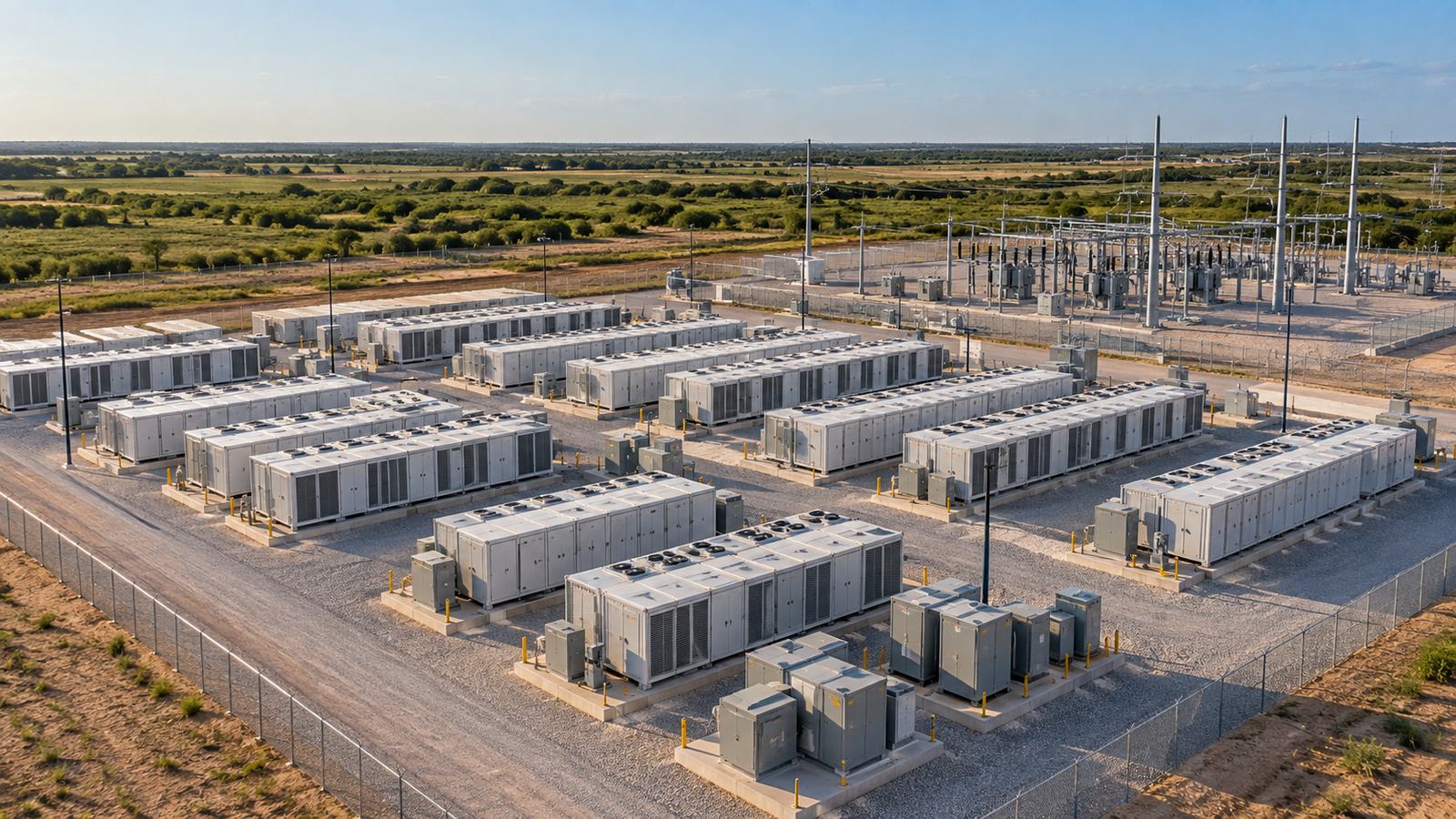
Two things happened to utility-scale development in Texas in the last eighteen months. Federal tax policy split solar and storage onto different paths, and the ERCOT battery market grew up fast enough that the easy money left. Both point the same direction: the durable value in a development position now sits in the grid connection, and storage is increasingly the reason to hold one.
Tax policy split the technologies
The One Big Beautiful Bill Act, signed July 4, 2025, rewrote the clean electricity credits. Wind and solar projects keep the Section 45Y and 48E credits only if they began construction by July 4, 2026 or are placed in service by the end of 2027. For a greenfield solar position originated today, the prudent underwriting assumption is no federal credit at all.
Energy storage was treated differently. Storage remains eligible for the Section 48E investment credit at full value for projects that begin construction through 2033, stepping down to 75 percent in 2034 and 50 percent in 2035 before ending. New foreign-entity sourcing rules apply to projects that begin construction after 2025, which puts supply chain planning into the development phase rather than leaving it for procurement.
The result is simple. A new standalone solar project in ERCOT has to stand on merchant or contracted economics alone. A storage project still carries a meaningful federal credit for most of a decade.
The battery market grew up
ERCOT’s operating battery fleet reached about 16.5 gigawatts and 28.8 gigawatt-hours by the second quarter of 2026, according to Modo Energy, after roughly doubling every year through 2024. Growth is now slowing, tracking closer to 40 percent in 2026.
That growth came with a correction. Enverus estimated ERCOT battery revenue fell from about $149 per kilowatt in 2023 to roughly $17 per kilowatt in 2025, as ancillary service markets that once paid most of the bills became saturated. Revenue now depends far more on energy arbitrage, congestion, and where a battery sits on the grid.
We read that as good news for disciplined developers, not bad news for storage. When every battery earned the same ancillary payments, location barely mattered. Now it matters a great deal. Positions near load growth, constrained transmission, and strong substations separate from the rest.
Load growth changes the map
ERCOT reported about 410 gigawatts of large loads seeking interconnection as of March 2026, roughly 87 percent of them data centers. Even a small fraction of that demand materializing reshapes where storage and generation earn their keep. Batteries sited near new load centers and the transmission that serves them have a structural advantage that a generic site does not.
Why the grid position is the scarce asset
ERCOT’s generation queue held roughly 453,600 megawatts of requests at the end of February 2026, including about 177,600 megawatts of storage and 162,900 megawatts of solar. Most of that will never be built. Across the U.S., Lawrence Berkeley National Laboratory found only about 13 percent of capacity that requested interconnection from 2000 through 2020 had reached operation by the end of 2025.
Panels and batteries are commodities. Land under executed control, with a workable path onto a strong part of the grid and network upgrade exposure understood early, is not. That is the asset a long-term owner is actually buying when it acquires a development position.
How Aurevia applies this
- Storage-led where the grid pays for it. We treat storage as the anchor of a position when location supports it, and size solar or other generation to the offtaker rather than the other way around.
- Interconnection first. Every site is screened on grid position before a landowner conversation, and upgrade exposure is a gate, not a footnote.
- Transact at interconnection. We sell positions at the milestone where development risk clears, to owners built to carry construction and operations.
- Supply chain planned early. Procurement requirements are built around each buyer’s and capital partner’s standards from the start.
The market stopped paying for batteries anywhere. It still pays for batteries in the right place. That is a development problem, and it is the one we work on.
This note is general market commentary for developers, buyers, and capital partners. It is not investment, legal, or tax advice, and it is not an offer to sell or a solicitation of an offer to buy any security. Sources: One Big Beautiful Bill Act (Pub. L. 119-21) as summarized by Kirkland & Ellis (Aug. 2025); Modo Energy ERCOT BESS buildout, Q2 2026; Enverus Intelligence Research (Nov. 2025); ERCOT large load and interconnection updates (March to April 2026); Lawrence Berkeley National Laboratory, Queued Up: 2026 Edition.